



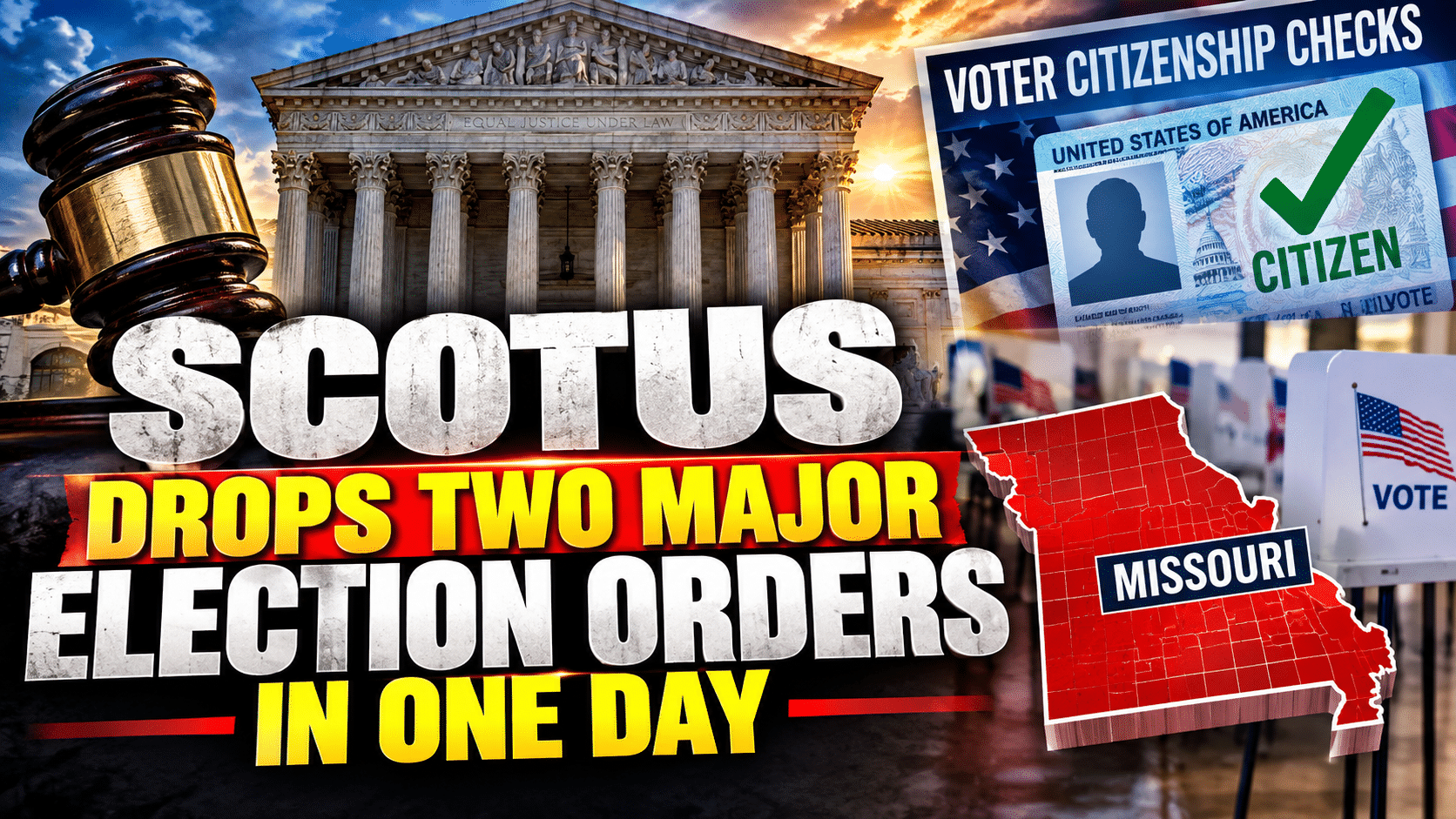
SCOTUS delivers MAJOR ruling on mail-in ballots
| Getting your Trinity Audio player ready... |
It amazes me that there is even a fight in politics over voting. Law abiding politicians swear to uphold the Constitution of our nation.
Yes the original Constitution did not establish a nationwide citizens-only voter qualification. However, following the Civil War, multiple constitutional amendments repeatedly identified voting as a “right of citizens of the United States,” while leaving states significant authority over voter qualifications subject to constitutional restrictions.
1. The Fourteenth Amendment explicitly connects voting and citizenship
After the Civil War, the Constitution becomes much more explicit.
The Fourteenth Amendment, Section 2 (1868) discusses the right to vote in federal and state elections being denied to male inhabitants who were:
“twenty-one years of age, and citizens of the United States”
This provision was originally connected to congressional representation, rather than being a general declaration that every citizen could vote. Constitution Congress
2. The Fifteenth Amendment uses even stronger language
The Fifteenth Amendment (1870) begins:
“The right of citizens of the United States to vote shall not be denied or abridged…”
It then prohibits denial of that right because of race, color, or previous condition of servitude. Constitution Congress
Notice the wording: “citizens of the United States.”
3. The same formulation keeps appearing
This becomes a recurring constitutional formulation.
The 19th Amendment says:
“The right of citizens of the United States to vote shall not be denied or abridged…on account of sex.” Constitution Congress
The 24th Amendment says:
“The right of citizens of the United States to vote in any primary or other election for President or Vice President…” cannot be denied because of failure to pay a poll tax. Constitution Congress
And the 26th Amendment says:
“The right of citizens of the United States, who are eighteen years of age or older, to vote shall not be denied or abridged…” because of age. Constitution Congress
So there is undeniably a strong constitutional pattern describing voting rights in terms of U.S. citizens.
And separately from that constitutional-history question, modern federal elections are governed by federal statutes that expressly prohibit noncitizen voting, with limited statutory exceptions unrelated to ordinary federal voting. That modern-law question is worth separating from what the Constitution itself says.
So the fight by President Trump to keep our nation a free nation of citizens who have a full voice in it’s affairs is a sacred duty. You have to ask, what motive do all the deceptive forces have that are fighting to block citizens only have the right to vote?
Romans 13
Let every soul be subject to the governing authorities. For there is no authority except from God, and the authorities that exist are appointed by God. 2 Therefore whoever resists the authority resists the ordinance of God, and those who resist will bring judgment on themselves. 3 For rulers are not a terror to good works, but to evil. Do you want to be unafraid of the authority? Do what is good, and you will have praise from the same. 4 For he is God’s minister to you for good. But if you do evil, be afraid; for he does not bear the sword in vain; for he is God’s minister, an avenger to execute wrath on him who practices evil. 5 Therefore you must be subject, not only because of wrath but also for conscience’ sake. 6 For because of this you also pay taxes, for they are God’s ministers attending continually to this very thing. 7 Render therefore to all their due: taxes to whom taxes are due, customs to whom customs, fear to whom fear, honor to whom honor.
Is it right to follow the righteous way of freedom of the citizens to vote? Is it evil to break the law and force elections to be packed with non-citizens that inflate or bend the outcome against the citizens will? Is your loyalty to the Constitution and laws of our country, or to your political party, no matter what? Even when they are breaking the law?
The Christian at the Ballot Box
Charles Finney on Voting, Character & Conscience
Does following Jesus Christ affect how a Christian votes?
For Charles Grandison Finney, the famous 19th-century evangelist and revivalist, the answer was unmistakably yes.
Finney believed Christians could not divide life into separate compartments—allowing biblical principles to govern church, family, and personal morality while leaving politics untouched. If a Christian possessed the privilege of voting, Finney believed the exercise of that privilege carried moral responsibility.
At the same time, Finney did not believe the church should become an arm of a political party or that ministers should turn their pulpits into campaign platforms for individual candidates. His position was more challenging than either extreme.
Finney called Christians to enter public life with biblical conviction, moral independence, concern for their neighbors, careful judgment, and a conscience accountable ultimately to God rather than a political party.
“Righteousness exalteth a nation: but sin is a reproach to any people.” — Proverbs 14:34
Voting as a Moral Responsibility
In his Systematic Theology, Finney discussed the Christian’s responsibility toward human government. Because government affects the lives, liberty, safety, and welfare of other human beings, Finney believed participation in government could not simply be dismissed as morally irrelevant.
Speaking specifically about citizens possessing the franchise, he wrote: “Every man having a right to vote…is bound to exert that influence in the promotion of virtue and happiness.”
Finney’s reasoning was straightforward. If government affects our neighbors, and citizens possess some influence over government, then the way citizens exercise that influence becomes a moral question.
This connects political responsibility with one of Christianity’s most fundamental commands: “Thou shalt love thy neighbour as thyself.” — Matthew 22:39
For Finney, voting was therefore about considerably more than protecting one’s personal interests. A Christian should consider the welfare of others.
“The Church Must Take Right Ground in Regard to Politics”
Finney became even more direct in his Lectures on Revivals of Religion: “The church must take right ground in regard to politics.”
That sentence can sound startling today, but the words immediately following it are equally important. Finney specifically cautioned his audience not to suppose that he wanted Christians to create a special Christian political party.
His concern was not establishing a political machine. It was establishing Christian moral responsibility.
Finney wrote: “Christians must do their duty to the country as a part of their duty to God.”
That statement summarizes much of Finney’s thinking. A Christian does not cease being a Christian when entering the voting booth. The same person who seeks to honor Christ on Sunday morning should seek to honor Him at work, in business, in family relationships—and in civic life.
Character Matters
One of Finney’s strongest concerns was the character of those entrusted with political authority. He urged Christians to determine whether a candidate was “honest and upright, and fit to be trusted.”
Elsewhere, Finney argued that Christians should resolve “to vote for no man for any office, that is not an honest man and a man of pure morals.”
That principle has an interesting biblical parallel. Exodus 18:21 says: “Moreover thou shalt provide out of all the people able men, such as fear God, men of truth, hating covetousness…”
Notice the qualifications: ability, fear of God, truthfulness, and integrity concerning money.
Exodus 18 was not describing an American election, so it should not be treated as a modern voting statute. Nevertheless, it demonstrates an enduring biblical principle: the character of those exercising authority matters.
“When the righteous are in authority, the people rejoice: but when the wicked beareth rule, the people mourn.” — Proverbs 29:2
Party Loyalty Must Never Replace Christian Conscience
Finney was particularly concerned about Christians surrendering their moral independence to political parties. He criticized the practice of voting for someone merely because “he belongs to their party.”
It is important not to impose today’s Republican-versus-Democratic political environment upon Finney. He lived in a very different political world and referred to controversies and factions such as Jackson versus Anti-Jackson and Bank versus Anti-Bank.
But the principle he articulated transcended those particular political parties: party membership does not determine morality.
Finney wanted Christians to examine candidates rather than automatically support whoever carried their preferred party’s banner. In effect, Christians should be able to tell every political party: Our votes cannot simply be assumed.
Could Christians Change the Quality of Political Candidates?
Finney believed they could. Suppose large numbers of Christian voters consistently refused to support candidates they considered dishonest or seriously immoral. Political parties interested in winning elections would eventually recognize that such candidates could cost them votes.
Finney therefore envisioned Christians exercising moral influence over political parties rather than allowing political parties to exercise unquestioned influence over Christians.
When Christians surrender their standards to political parties, parties have little reason to respect those standards. But when voters maintain genuine moral independence, political organizations have an incentive to take their convictions seriously.
Should Ministers Preach About Politics?
Finney addressed this question directly. In 1845, after controversy surrounding one of his sermons, Finney explained that ministers should instruct Christians concerning their responsibilities “as citizens under an elective government” and teach “the great principles upon which they are to be actuated in coming to the polls.”
Finney even complained: “The pulpit has been too long almost silent upon this subject.”
But Finney immediately established an important boundary. He did not believe Gospel ministers should devote themselves to “influencing the votes of men in respect to a particular candidate or election.”
The distinction is significant: teach biblical principles, Christian responsibility, moral questions affecting society, and discernment at the ballot box—but do not turn the pulpit into a campaign headquarters for a particular candidate.
Finney’s ultimate concern remained spiritual. He wrote: “there is no real reformation which does not begin at the heart.”
The Gospel Must Remain Central
Finney was first and foremost an evangelist. He believed the great work of Christian ministry remained “the conversion of sinners, and the sanctification of the church.”
Finney did not believe political reform could substitute for spiritual regeneration. Instead, he expected political morality to flow from transformed people.
Christ transforms the heart. A transformed heart changes the person. A changed person begins making different moral choices. Those choices inevitably affect family, business, community—and civic life.
What Happens When Every Candidate Is Imperfect?
No candidate perfectly embodies every biblical principle. Christians therefore must exercise judgment.
Rather than allowing a political party, television personality, social-media influencer, pastor, or friend to make that decision for us, Christians can ask serious questions.
What biblical principles are involved?
Before asking what a political party says, ask what Scripture actually teaches.
What is known about the candidate’s character?
Christians should distinguish verified facts from rumors, accusations, partisan propaganda, and social-media claims.
What policies has the candidate actually proposed or implemented?
Campaign rhetoric should be distinguished from documented positions and actions.
Is the candidate capable of fulfilling the responsibilities of the office?
Character and policy are important, but governing also involves practical responsibilities associated with the particular office.
What are the reasonably foreseeable consequences?
Voting involves choices among real alternatives, not imaginary perfect candidates.
Am I applying my standards consistently?
Would something we condemn when the opposing party does it suddenly become acceptable when our preferred party does it? Christian integrity requires consistent standards.
Can I make this decision before God with a clear conscience?
Ultimately the Christian answers to Someone higher than any political party.
Christians Should Be Especially Concerned About Truth
Political environments frequently reward exaggeration. Social media can make the problem worse. A dramatic claim can travel around the world before anyone asks whether it is actually true.
Christians should resist that temptation even when misinformation benefits their preferred political cause.
Proverbs 18:17 warns: “He that is first in his own cause seemeth just; but his neighbour cometh and searcheth him.”
Christian voters should investigate claims, examine evidence, distinguish fact from opinion, and be willing to correct themselves when information proves false. Truth does not become less important during an election.
Our Highest Citizenship
Christians should care about government, pray for government, and seek justice and righteousness. But government can never occupy God’s place.
“For our conversation [citizenship] is in heaven…” — Philippians 3:20
“We ought to obey God rather than men.” — Acts 5:29
Party is not Lord. Candidate is not Lord. Government is not Lord. Jesus Christ is Lord.
Seven Questions to Ask Before Voting
- Have I prayed seriously about this decision?
- What biblical principles genuinely apply?
- Have I investigated the candidates instead of simply accepting what my political side tells me?
- What do reliable evidence and the candidates’ records show about character, policies, and qualifications?
- Am I applying the same moral standards to candidates I like and candidates I oppose?
- Am I considering my neighbor’s welfare as well as my own interests?
- Can I make this decision before Jesus Christ with a clear conscience?
The Ballot Box Doesn’t Belong to Caesar Alone
Jesus said: “Render therefore unto Caesar the things which are Caesar’s; and unto God the things that are God’s.” — Matthew 22:21
Christians live under earthly governments while ultimately belonging to another Kingdom.
Charles Finney’s challenge was that believers cannot simply say, “God governs my religious life, but my political life belongs to someone else.” Instead, Christians must ask: How do I honor Christ here too?
Finney expressed it powerfully: “Christians must do their duty to the country as a part of their duty to God.”
Rather than simply voting for someone because “he belongs to their party,” Finney challenged Christians to consider whether the candidate was “honest and upright, and fit to be trusted.”
Don’t ask only: What does my party want me to do?
Ask: What is true? What does Scripture teach? What do I actually know about the candidates and their policies? Am I applying biblical standards consistently? What promotes the good of my neighbor? Can I make this decision before Jesus Christ with a clear conscience?
Finney’s answer was not to abandon the ballot box. It was to bring Christian conscience with you when you enter it.
Primary Sources
Charles G. Finney, Lectures on Revivals of Religion.
Charles G. Finney, Systematic Theology, section on Human Government.
Charles G. Finney, Lectures to Professing Christians.
Charles G. Finney, 1845 remarks concerning ministers, politics, Christian citizenship, and conduct at the polls.
Charles G. Finney’s correspondence concerning political and abolitionist questions in the 1850s.